
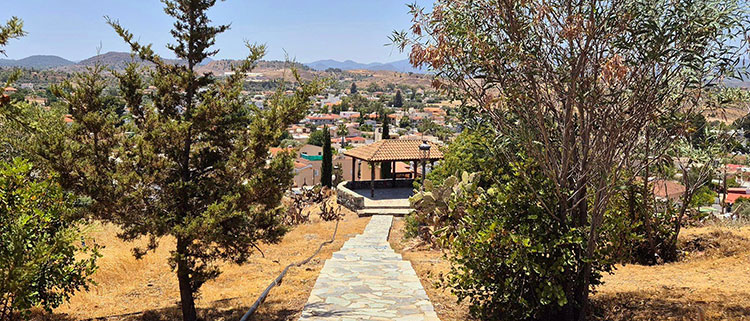
Agia Varvara
Agia Varvara is located approximately 22 kilometers south of Nicosia, on the right side of the junction of the Nicosia–Limassol–Larnaca highways. The village is built at an altitude of 310 meters above sea level.
The community is characterized by several barren and uncultivated areas. The cultivated land mainly produces cereals, especially wheat and barley. Fodder plants, olive trees, and vineyards are also grown, while almond trees become a true ornament of the plains, particularly during springtime.
Many years ago, a small village called Saint George existed in the area where Agia Varvara stands today. Around 620 years ago, the village church was destroyed by fire. According to local tradition, only the icon of Saint Barbara remained untouched by the flames. The villagers rebuilt the church near the old one and dedicated it to Saint Barbara, from whom the village eventually took its name.
The history of Agia Varvara dates back to ancient times. Evidence of its long history can still be seen in the caves found throughout the area, many of which have ceilings carved in the shape of crosses. Some of these caves are quite large and are believed to have served as catacombs for the early Christians.
Historical sources mention that during the Frankish era, Agia Varvara was a feudal estate. During Ottoman rule, 15–20 Turkish families settled in the village. At the same time, many Turks moved into the neighboring village of Nisou, forcing several local residents to relocate to Agia Varvara.
In 1881, the village population was recorded at 449 inhabitants. Over time, the village gradually developed. By 1991, the population had grown to approximately 1,200 residents, while in 2001 it reached 1,421 inhabitants.